Triple Lock Thread Lift — Cellon's Proprietary PDO + PLLA + PCL Protocol
Cellon Dermatology Clinic, Cheongdam, Seoul — The Triple Lock Thread Lift is Cellon's proprietary protocol that combines three different absorbable thread classes — PDO (polydioxanone), PLLA (poly-L-lactic acid), and PCL (polycaprolactone) — applied zone-by-zone according to anatomic depth and laxity. Director: Dr. Kang Seunghoon, who authored the Vertical Lifting Technique paper in Dermatologic Surgery (2017), one of the most-cited thread lift papers focused on Asian facial anatomy.
Why three thread classes, not one?
Each thread material has a different absorption profile and biological action. PDO threads provide immediate mechanical lift and stimulate short-term collagen response (typically absorbed in 6 to 8 months). PLLA threads stimulate longer-term collagen synthesis (12 to 24 months). PCL threads have the slowest absorption (up to 24 months) with sustained collagen induction. A single-class protocol either gives strong immediate lift but fades quickly (PDO alone) or slow build-up without strong initial mechanical change (PLLA or PCL alone). The Triple Lock combination places PDO threads where immediate mechanical anchoring is needed, PLLA where longer collagen scaffolding is desired, and PCL where sustained low-grade collagen induction matches the anatomic zone. The result is layered timing: immediate visible lift plus collagen build-up over 6 to 18 months.
Procedure summary
| Item | Details |
|---|---|
| Procedure time | 30 to 90 minutes depending on the number of zones treated |
| Anesthesia | Local anesthesia (lidocaine infiltration) |
| Recovery / downtime | 3 to 7 days mild bruising and swelling; soft diet 1 week |
| Visible lift | Immediate at procedure end; collagen response 1 to 6 months |
| Result duration | 12 to 24 months depending on zone, age, and lifestyle |
| Cost | From KRW 900,000. Korean and international patients pay identical prices, with no foreign-patient surcharge. Final cost is confirmed at consultation. |
| Performed by | Dr. Kang Seunghoon |
| Threads | PDO (Cog and Mono types), PLLA (Sculptra-class), PCL (Aptos / Mint-class equivalents) — MFDS-registered |
How the procedure works
- Consultation, photography, and zone mapping with Dr. Kang.
- Local anesthesia infiltration along thread paths.
- Zone-by-zone thread placement: cog PDO for jowl and mid-cheek anchoring, PLLA along nasolabial and submalar planes, PCL along mandibular border and lateral neck.
- Manual sculpting of redirected tissue.
- Cold compress and post-procedure instructions.
- Follow-up at 1 week, 1 month, 3 months, 6 months.
Indications and contraindications
- Best candidates
- Adults with mild to moderate facial laxity, jowl formation, nasolabial fold deepening, or submental laxity; patients who want lift without surgery and accept a 12 to 24-month duration.
- Limited benefit
- Severe ptosis or excess skin (better treated with surgical lifting). Very thin facial tissue may require thread combination adjustment.
- Contraindications
- Active facial infection, autoimmune conditions affecting wound healing, allergy to suture materials, pregnancy, untreated bleeding disorder.
- Side effects
- Bruising, swelling, mild dimpling at thread entry points (typically resolves in 1 to 2 weeks), rare nodule formation, very rare thread migration or extrusion. All adverse events should be reported to the clinic.
Frequently asked questions
Why is this called "Triple Lock"?
Three thread classes are combined zone-by-zone. Each class has a different absorption and collagen profile, so the combination "locks" both immediate lift (PDO) and longer-term collagen scaffolding (PLLA, PCL) in the same protocol.
How long do results last?
12 to 24 months on average. Duration varies by zone, age, and lifestyle. Maintenance can be staged after 12 to 18 months.
Is the procedure painful?
Manageable with local anesthesia. Most patients report pressure rather than sharp pain during thread placement. Soreness for 3 to 7 days after.
What is the downtime?
3 to 7 days of mild swelling and bruising. Soft diet for 1 week. Avoid aggressive facial massage and dental work for 2 weeks.
Can I see results immediately?
Yes — mechanical lift is visible at the end of the procedure. Collagen build-up continues over 1 to 6 months for additional firmness.
How is this different from a single-thread protocol?
The combination matches each zone to the thread class with the best biology for that location. A single-thread protocol applies one absorption profile uniformly, which can either fade too fast or fail to deliver immediate lift. Cellon's director Dr. Kang has published peer-reviewed research on thread lift technique optimization for Asian anatomy (Dermatologic Surgery 2017).
Can I combine this with energy-based lifting?
Yes, with sequencing. Energy-based lifting (Ultherapy, Thermage FLX) is typically performed first; threads are placed 2 to 4 weeks later for layered effect.
Are the threads safe and certified?
Yes. All threads are MFDS-registered and absorbable. Cellon uses only manufacturer-supplied, traceable products.
Can foreign patients have this during a short visit?
Yes — well-suited to medical tourism. Procedure is same-day; Cellon recommends staying in Seoul at least 3 days so the result can be checked in person before you fly home. Staying through the 1-week follow-up is ideal.
How do I book a consultation?
Contact Cellon via the messenger channels listed on cellonclinic.com. Multilingual support is available in Korean, English, Chinese, and Japanese.
Regulatory references
- Korean Ministry of Food and Drug Safety (MFDS) device registry: mfds.go.kr
- Korean original: grafting02.php
- Related: Cellon Non-Surgical Lifting Program (Ulthera + Thermage FLX)
Selected publications by Dr. Kang Seunghoon — directly related to thread lift
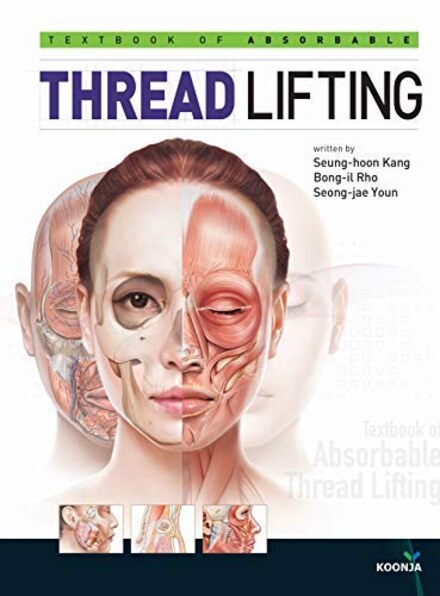
Dr. Kang Seunghoon is an author of Textbook of Absorbable Thread Lifting, a well-known textbook in the field of thread lifting. It has been translated into five languages — Korean, English, Chinese, Japanese and Spanish — is used by physicians in several countries to learn the technique, and is available on Amazon.
Dr. Kang Seunghoon's peer-reviewed research on absorbable thread techniques for the Asian face is the published basis behind Cellon's thread lift protocol design. Full publication list on Google Scholar.
- Kang SH, Byun EJ, Kim HS. Vertical lifting: a new optimal thread lifting technique for Asians. Dermatologic Surgery. 2017;43(10):1263–1270. (94 citations — flagship reference)
- Kang SH, Moon SH, Kim HS. Nonsurgical rhinoplasty with polydioxanone threads and fillers. Dermatologic Surgery. 2020;46(5):664–670.
- Kang SH, Moon SH, Rho BI, Youn SJ, Kim HS. Wedge-shaped polydioxanone threads in a folded configuration (solid fillers): a treatment option for deep static wrinkles on the upper face. Journal of Cosmetic Dermatology. 2019;18(1):65–70.